Showing posts with label Living Abroad. Show all posts

Sunday, July 29, 2012

Luck of the Gringo

Well, I arrived in El Porvenir last night. Now that I’ve arrived I’m safe. And I’m as sound as I was when I left the States, for what that’s worth. But this time the getting here was an exercise in redefining “luck.”

At the airport in DC, I arrived with adequate time to make my flight. Except that the airline had apparently scheduled more early morning flights than it was willing to supply to staff to check in. You see, as the airport doesn’t open until a certain hour, there is only so much arriving early that actually helps. You arrive too early, and there is no one to check you in. You arrive on time, as did everyone else, and there aren’t enough people to check you in. Bad luck! Thankfully, a nice TSA officer passed me forward in the security line (with the required lecture of being earlier next time…sigh!) and I had a decent layover in Miami to let my baggage catch up. Good luck!

I arrived in San Pedro Sula with my 100 pounds of luggage (almost all of it supplies for the PASA workshops) and discovered that the bus company has changed its schedule and the bus to the central bus depot had already left and there wouldn’t be another one leaving the airport until the evening. Bad luck! But, I had plenty of time to take a taxi to the central bus depot and get on the afternoon bus to Ceiba. Good luck!

So, off I go in the taxi. And we are about half way there and I start to send a text message to folks back home that I’ve arrived safely when, BAM! We get into a fender bender. Bad luck! I delete the message, decide to wait to send any news until I make it to El Porvenir, and just not tempt fate. As for the fender bender, the traffic in front of us was stopped due to a police checkpoint in the road. Our driver thought to pull to the right, avoiding it being a head-on collision, and thankfully there was no traffic in the lane to our right. We walked away without a scratch on our bodies and minimal damage to the vehicles. Good luck!

I made it onto the bus for Ceiba and proceeded to watch the movie they were showing, which wasn’t anything amazing or riveting. Bad luck! But it takes place on a tropical island and there were lots of young men in swim trunks to look at. Good luck!

As we neared Ceiba, we found ourselves in the hours of traffic back up after a four car collision on the bridge over the Rio Danto west of town. I couldn’t figure out where I packed the number for my friends who were picking me up to let them know what is happening, and when I arrived, they weren’t there. Bad luck! However, I flagged down the last taxi in the parking lot before it pulled away and it turned out to be Cesar, a taxista I know from El Pino, just the other side of El Porvenir! He gave me a ride into Porvenir and had a numbers for the folks there so I could call to let them know I was coming. We arrived safely, and 18 hours after my adventure started I finally finished it. Good luck!

I guess, when the bad luck gets balanced out by the good luck, you know the universe wants you to be exactly where you are.

Saturday, July 9, 2011

Experiencing how the political is personal

"The personal is political." It's a beautiful adage from the feminist revolution. And it goes the other way. The political is personal.

Here in the U.S. we often think it odd the way world events can suddenly collide with daily existence. But every time it happens to me, I realize again to what extent the seemingly impersonal political and economic and social issues of this world are actually personally experienced realities. The Honduran teacher strikes are students missing out on their right to public schooling. The economic recession is a child going to live with grandparents when his parents’ house goes into foreclosure. And the strife in any number of countries leads to a family leaving their home and trying to grow and succeed in a place where they don’t know the culture and don’t speak the language.

That’s why I got into international education. My work abroad has allowed me to help students prepare themselves to face their lives with the resiliencies and skills they need, as well as providing them with the chance to comfortably and securely gain cross-cultural understandings and skills. My work here in the U.S. allows me to do the same, with the extra facet of being a bridge for my students to understand and access the culture that surrounds them, hopefully without losing any understanding, access, or membership in the culture of their home.

Today the world celebrates the democratic emergence of a new nation, South Sudan. I reflected on this coming event yesterday while I sat with a young Sudanese girl, L. (Because I respect the privacy of my students and issues of confidentiality, I will from now on refer to students anonymously.) She is attending the summer program at the family literacy school where I teach, although she is not in my class. That day we were on a field trip to the Smithsonian Folklife Festival on the National Mall. We had walked through the Peace Corps themed activity area, where the kids had received “passports” which were stamped when they took part in each activity. We built a wall with bottles like they are now building in Guatemala. We helped paint a world map (that included South Sudan as clearly separate from Sudan!), and we made Malian mud cloth bracelets.

As we recovered from the heat and enjoyed a brief cool breeze under one of the dining tents, L struck up a conversation with me about her “passport.” We talked about all the activities in which she had taken part and I helped her pick out words she didn’t know in the booklet. We came across the blanks in the front cover that called for her name and nationality. I explained that nationality is where you are from.

L: Where are you from?
K: I’m from Texas.
L: I have a cousin in Texas!
K: You do? That’s great!
L: But I don’t know where Texas is.

So we looked at the world map in her passport booklet, marking DC and Texas.

L: I’m from Sudan. Well. (Pause.) Hang on.

She turned to her mother and spoke with her in their home language. There was some back and forth. Her mother, pregnant and tired, was also interacting with her 2 year old brother and 4 year old sister. L was obviously repeating herself to make sure her mother really understood her question. Finally satisfied, she turned back to me.

L: Yes. I was born in Sudan. (Her emphasis. I had not asked. It can be a complicated question for any child, especially an immigrant child.)
K. Okay. Let’s look at where Sudan is on the map.

So we marked the general location of Sudan with an X (it wasn’t a big map, thankfully). L wanted to label it the way we had labeled DC, but she didn’t know how to spell it. I spelled it out loud, and at her request I wrote it down so that she could copy it. After spelling it successfully several times in random places on random pages, she finally turned to the front cover and wrote “SUDAN” on the previously empty line for a nationality.

L’s personal experience was a mixture of culture, identity, literacy, and all the underlying structures and skills that support these facets of development. And there I was, to some extent experiencing it with her. The day before millions of her former countrymen got the chance to have a very similar experience.

Tuesday, November 16, 2010

From estadounidense to US-American

I have struggled with my geographical self-definition for many years now. Ever since I learned the word “estadounidense” in Spanish.

Unitedstatesian.

Finally, I had evidence that there could be a word to replace “American” as a descriptor for a person from the United States. After all, it seems usurping to describe ourselves as Americans, when we are hardly the only nation in THE AMERICAS. Nor are we the largest. Sadly, being the richest seems to make us entitled to taking what we want, at least it has in the past, and so we came to describe ourselves as “Americans,” forcing all the other americans to define themselves differently.

But “unitedstatesian” hardly rolls off the tongue.

I’ve tried a lot of different phrases.

North American. But we aren’t the only North Americans. It could make sense to the extent that Canada and the U.S. are very similar, but there are also vital differences between us. Canadians (and Mexicans, especially) might resent my describing myself and my values and culture as North American.

[Brief geography lesson: Here in the US we teach that there are 7 continents, and Central America is technically part of North America. In Honduras, they teach that there are 6 continents, with the Americas being one continent split into three regions: north, central, and south.]

I didn’t give up. I tried “US Citizen”…but there are many who aren’t citizens who do identify as residents of the U.S.

US Resident…but there are many who reside here without feeling cultural ties here.

And, finally I hit on it. US-AMERICAN. So simple. So clear. Borrowing from the way we structure our self definitions within the US (African American, Irish American, Native American, Latin American, etc.)

I am US-American.

In English.

But in Spanish I am still estadounidense.

Thursday, August 5, 2010

On the Road in Bolivia

It’s always a good idea to take one’s life in one’s hands now and again, just to keep a sense of the value of life and health, right? Once in a while can be a daily occurrence here, I’ve found. And at times I can feel that my perspective of what is safe and what is really out of the question could become about as fuzzy as three day old leftovers in the fridge.
Cars

I’ve travelled in all manner of ways here (save bicycle and horse), but by far the most common mode of transport is car. This might be in a taxi or a mini-bus (full size buses are only for inter-city transport) or in a colectivo (a larger car or mini-van that travels between the urban and rural areas, and only leaves once full of passengers.)
It is always important to remember that laws (and the accompanying concepts of justice) will change from culture to culture. This includes the concept of “right of way.” Here in Bolivia it seems that it is not the pedestrian who has the right of way, and cars will regularly honk to hurry passengers across the street. I’ve more than once come near to denting the hood of a taxi or mini with my fist when they’ve decided to get too close. (That’s my fight response kicking in when flight would be impossible.)
Cars aren’t always honking to warn off pedestrians. It is also the accepted thing to do in order to cross almost all intersections. You see, traffic lights and stop signs are not terribly common, and rather than slow to a stop to ensure no other cars are coming, it really saves time to just honk and hope any other cars hear you. At least most streets are one way, so that simplifies the number of directions in which you have to focus your attentions.
At night there is less honking, and it is more common that cars will flash their headlights as they approach an intersection. In a fairly well lit town, this makes me cringe, as that flash of light is often very difficult to see. But then again so are many of the cars, because actually using your headlights is not an altogether common occurrence here, either. When I’ve asked about this strange habit (or rather lack of a habit), people have pointed out that the city is quite well lit, so you don’t really need to lose your headlights to see. When I bring up the idea that headlights are also useful as a way to be seen (rather than only to see) this seems to be a new idea for many. I’ve often dodged cars and motorcycles that I didn’t see coming down the street at night.
Headlights are not the only lights I find myself worrying about when it comes to riding in cars here in Bolivia. There are also the dashboard lights to be concerned about, or rather, to try my hardest to ignore, because they are almost always lit. My worst moment to date was when I found myself perched on the middle front seat of a minivan colectivo travelling from Oruro into the rural area of Caracollo. (“Wait,” you say, “since when to minivans have a middle front seat?” Well, a box and blanket squeezed in between the bucket seats is enough to make another fare earning seat, don’t you know!) So there I was, sans seat belt on a blanketed crate, cruising down the highway at highway speeds and trying not to look at the dashboard where the gas warning light, check engine light, the airbag light, and the anti-lock brake system light were all lit. (I comforted myself with the idea that it was nothing more an electrical short in the dash, and when I finally dismounted a half-hour later in Oruro I silently celebrated the fact that I hadn’t had to find out if my comforting imaginings were true or not.)

Anti-lock brakes? Well that was a newer Toyota minivan, but in reality most cars here are hardly so new. In fact, bolivian cars seem to have more lives than cats. One night I was riding in a taxi and trying to understand why there was a gaping hole in the dash where there should have been a glove box on the passenger side. Only slowly did it dawn on me that the gaping hole was the original location of steering column, which had been switched from the right hand side (British style) to the right hand side (as is used in most of the Americas.) So in essence, the driver was driving through the glove compartment.

Buses

The only ways to travel between cities here (unless one is lucky enough to own or know someone who owns a car) is to travel by bus or train. By far the most common and most thorough network is that of buses. This is how one travels between La Paz and Oruro and Cochabamba. The price is excellent, only three bucks! But for those three dollars, you are to some extent taking your life in your hands. Bus accidents are common, and there have been so many lately that even the Bolivians are remarking on the fact. I actually met a German man whose bus between La Paz and Oruro had been in a head-on collision two days prior. And one of the members of the parent association at a school Save the Children works with was injured in a bus accident in La Paz. Bus drivers will regularly pass slower trucks, and highways are often two lane affairs with nothing that resembles a shoulder, unless one counts either the valley below or the sharp face of the mountain on the other side. So, I always feel a little lucky to have arrived safely, even if the bus ride itself was intolerably nausea inducing.
Trains

I refer to travelling by train as the $15 luxury here in Bolivia. Safer by far and much more comfortable. The tracks extend south from Oruro only and are hardly what most people would call luxurious or smooth, but to me they make a lovely change from the rough roads and alarming driving habits. And the huge windows let you look out at the changing (or rather not changing all the much) landscape of the Altiplano (where I’ve decided that the sparse clumps of grass look like tribbles from the original Star Trek.)
All in all, travelling around Bolivia is easy and affordable, but rarely comfortable or altogether perfectly safe by North American standards. That said, it’s better to travel than to stay in one place. I can’t imagine staying in one place or not experiencing all that the world has to offer.

Monday, July 19, 2010

It’s not exactly homesickness…

There’s something so strange about being sick when you are far from your home culture. I’ve noticed it before, but especially here in Bolivia. I’ve had an acute sinus infection over the last week, and as I emerge the other side of it (knock on wood) I feel like I’ve been somewhere else all together. Is it the altitude? I feel like I’ve started all over again in terms of adjustment. Climbing a flight of stairs winds me and sends me into a fit of hacking coughs. Is it the sinus medication? I sleep half the day to constant dreams of wild nonsense that when I’m asleep have seemingly immense Lewis Carroll-like meaning. Awake, I feel like I’ve lost my Spanish…especially verbs. I constantly conjugate verbs incorrectly and am unable to correct myself. Maybe it is the same when at I am at home and speaking English and it is only the lack of familiarity here that emphasizes this facet of illness. The world in which I felt so comfortable just a week ago now feels unfamiliar all over again. I can’t follow conversations, cross-cultural communication that I could work through rationally gets me angry and frustrated and, when combined with sinus pressure and fever, I find myself pushed to tears. The simple tasks of life, like laundry and washing the dishes, usually invigorating times where I can think, are at best exhausting enterprising and at worst insurmountable obstacles. All taste for adventure and new experience has dried up, not to be replaced by a wish for the familiar but a hope for the easy and simple. And like all illnesses and setbacks, this too shall pass, and in the mean time I just keep chugging along, taking care of myself as best I can and taking it easy whenever I can until the energy kicks back in. Life goes on and there is work to do.

Late winter has begun to settle into Oruro. I’ve been warned that August is windy, but the winds seem to have arrived already. When I go to retrieve my clothes hung out to dry on the roof, I must unwind them from around the line and search for the buried clothespins. The air is so dry here that even my tepid wet clothes appear to steam when I hang them up in the bright morning sun. Yesterday was the first precipitation I have seen since I arrived, a lightly falling mixture of snow and icy rain that momentarily cleansed the air of its constant dust. It’s finally begun to feel truly cold, the unrelenting kind of cold that is hard to ward off even when wearing 3 layers of clothing. I’ve been told that I look like I’ve lost weight, but the extra layers of long underwear make my pants fit more or less as always.

Despite the cold, fruit continues to come in from the lower altitude valleys, and I’ve fallen in love with what they call “mandarinos,” a hybrid between a true mandarin and the more common orange. We set them out in the sun on the window sill at the beginning lunch so that they make a deliciously warm dessert. They peel easily and break into perfect segments and are so juicy that I often squirt myself in the face as I go about removing the seeds from a section before popping it into my mouth.

It is excellent to feel myself getting back onto my own two feet after a week of being out-of-it-kinds-of sick. I’ve moved to a room on the second floor of the house and the window provides me a lovely view of the street, from which I watched a small parade this morning. The participants were dancing the “Morenada,” one of the traditional dances for which Oruro is famous. Yes, I’m even beginning to tell the different traditional dances apart. Looking out the window now, however, I can’t tell if the sky is just a dusty dusk or if another storm is coming in tonight. The garbage men are coming soon. I hear their harbinger, a junior employee no doubt, banging his two pieces of metal together as he passes up the street. It’s time to bring in the wash and cuddle up to the space heater with my neglected research materials.

Siempre,
Kati

Tuesday, July 6, 2010

Partying bolivia Style!

I haven’t written in a while, not the least because I’ve been busy getting to know how to have fun here in Bolivia (and I’ve been working hard too, I swear!)
This past weekend I was in the city of Cochabamba for a teachers’ workshop on creating and interpreting evaluations. Now, the workshops weren’t terribly party-like but the after-hours festivities were a good break from the constant work. And it turns out that Cochabamba has a fairly good nightlife!
One evening I went out with the education team I’m working with. We found ourselves at a bar, enjoying the wide range of cocktails available here (just about anything can be imported for a price!) We ended up playing a dice game called “cacho,” which is best described as something between yahtzee and poker.

I picked it up by the second game and look forward to teaching it to folks when I get back to the states. A basic description is that each person keeps track of their score on something that looks like a tic-tac-toe board (see below) and each game lasts ten rounds. After you roll the dice using the leather cup (and everyone has their own unique style of doing so) you can choose to reroll some or all of the dice once to try to improve the outcome. After you are done rolling, you count the best score you can. If you can’t score in any of the spots, you have to choose to put an X in one of the boxes. Ones are referred to as “balas,” fours are referred to as “cuadras,” a straight is called an “escala,” and a full house (2 of a kind with 3 of a kind) is simply called a “full.” If you turn your cup over when you roll your dice and say “boteo,” that means you can turn one die over and use it’s opposite side if you want to. And of course, you can turn it into a gambling game!
My second night out in Cochabamba I was on my own, taking an extra night to stay in the city after the workshop was over in order to enjoy the warm valley climate for as long as I could. While partaking in a delicious Huari (by far the best of Bolivian beers) and a plate of spaghetti, I met a guy just a couple of years younger than me. He was selling handmade bracelets to pay for his room at an “alojamiento” (a very basic hotel) while figuring out his next move, having come from his native Ireland to travel through South America when he ran out of money in Cochabamba.
I could tell from his accent that his first language was English, so I figured he had to be suffering for lack of beer (especially if he was European or Australian.) We ended up hanging out until the wee hours of morning, both of us glad to have someone with whom we could speak English for a while. Turned out there was an Irish bar not far from where I was staying, so there we were in an Irish bar, drinking Bolivian beer, watching a Flamenco group, and chatting with a couple of Frenchmen who are working in Bolivia for a water sanitation program. This big ol’ world can really come together for a good time!
Previous to my adventures in Cochabamba, I found myself dancing the night away at the graduation party for one of the office interns here in Oruro. I was introduced not just to dancing in the Bolivian style (fairly simple steps thankfully!) but also to a Bolivian liquor called Singani, which tastes fairly lovely when mixed with 7Up.
An undergraduate graduation is a big deal here, as it takes a lot of years and a lot of financial sacrifice. Plus it holds the promise of a securely middle class, upwardly mobile future. Systems engineering, as the IT program is called here, is a really popular major, as it is something desperately needed for development and promises good employment. The graduate’s parents were so proud they cried, and the graduate cried too. I’ve never thought of a graduation party as a sentimental thing, but then again, getting an education was never an enormous challenge in my life, not like it is here. It reminded me that the work I do is important, helping to make sure that kids are prepared to take on the educational challenges that come up for them in their lives, despite the challenges they face.
And I thought I was just going out for the dancing and the alcohol!

Monday, June 21, 2010

The Dancing Bolivianos!


I’ve been able to take part in two different cultural events so far, one a dance festival put on by groups of special education students and the other a costume contest where parents were competing for prizes for their children’s classroom by trying to make the best costume for the traditional dances using only recycled materials.
The special education festival was marvelous. Save the Children hosts it every year, and because the population of special education students is fairly small, they invite some of the high schools to send students to help support the event. They were excellent supporters, dancing in the stands and cheering for the groups dancing.


I was amazed not just by the beauty of the traditional dances but also by how very well they were performed by the different groups of students. I had never realized that I held an assumption that the many problems that accompany conditions like down syndrome would severely hamper the person’s ability to dance. I learned that day how wrong this assumption is. These kids were great!


The other wonderful thing was how space was made for all ability levels. It didn’t matter if soemone couldn’t walk or if a child was too young to follow complicated choreography. There was a role for everyone who wanted to take part and someone to accompany those who needed assistance.


It was beautiful to see these kids get a chance to show off their abilities and to take pride in their own culture while exploring cultures of other countries. There were dances from all over Latin America as well as from Africa and North America (particularly great North American dances included the can-can and “Thriller!”)


The costume contest was an awesome idea to both share Bolivian culture and spread the message about ecology and recycling, all in a celebratory and creative way. Among favorites were the Incas’ costumes made completely from aluminum cans (mostly beer), the colonial/republic era dress made entirely of newspapers, the Flintone’s characters decked out very accurately using only yogurt wrappers, and the dancing ears of corn.


I was ecstatic to combine my experience with crafting from recycled materials with my understanding of how to create a scale to judge the contestants as equally as possible. And I found myself inspired by many ideas of new recycled crafty ideas. Maybe I’ll even do a workshop with some of the kids while I’m here!


Sunday, June 20, 2010

He’s got the feva’!

Well, as luck would have it, the other estadounidense (American) in the house has come down with typhoid fever. For those who aren’t familiar with food-borne pathogens of the developing world, it’s something you can get when you eat food or drink water that’s been handled by someone who has or carries the disease and forgot to wash their hands when they last used the restroom. You get a fever and a nasty case of the runs, which can put you in danger of dehydration. Untreated by antibiotics, it can lead a whole host of nasty abdominal issues. And, it is endemic here in Bolivia.

There is a vaccine, in fact two, but nothing in this world is completely fool proof. I last took it two years ago, and I took the live bacteria form (a week of pills) which I’ve always heard has better and longer results than the dead bacteria injection (which my poor housemate is pretty sure he got before leaving the states.) I’m being very careful, but I also figure I’m the one in the house least likely to get it at this point, all factors summed up together.
I have henceforth exiled the poor chap from the kitchen until he has not had a bout of the liquid poo for twenty four hours. I worry what our older dueƱos (landlords) would go through if they got the bug, especially Dora who has had a brush with cancer and has diabetes. I’m scrubbing surfaces like a fiend and cooking for the sick boy. It’s amazing how a 17 year old male can still have an appreciable appetite even amongst such nastiness!
I’ve had some nasty run-ins (pun intended) with similar diseases (particulary e.coli and salmonella) so I really feel for the guy. It’s no fun to be sick, and to be away from home in a foreign culture where you don’t speak the language fluently makes it a hundred times harder! And he’s so young to boot!
I found myself offering him some cultural advice last night (day two of the worst of his symptoms.) After all, think of how many kids get this or something like it on a fairly regular basis because they lack basic sanitation facilities. As a result they can’t grow or develop as they should. It’s not the most comfortable way to become sympathetic to the realities of poverty, and it is a little bit like the “offer it up for the soul’s in purgatory” line I heard all the time in Catholic school, but at least it gives one’s suffering some meaning the large scheme of life and personal development.

Thursday, June 17, 2010

El Oro que es Oruro (Oruro, Golden Town)

Due to requests (and the fact that the weekend finally permitted me adequate time) I can now provide you with some visuals of the city in which I am living here in Bolivia.

Oruro is in the Altiplano, which is a narrow slip of flat land high in the Andes mountains. Here are some pictures from one of the highest points in town (a lighthouse built to commemorate the spot as where the current Bolivian flag was first flown.) This will likely become one of my favorite places as it is quiet and the air is clear of the constant vehicular exhaust caught in the streets below. Oruro is nestled against the eastern mountain range, but the western range isn’t far away as you can see here.


Because I’ve been asked to provide more images of my accommodations, here are a couple of pictures…


My two favorite places in town so far are the lighthouse, as I said before, and one of the central plazas where there are actually three fountains that run on Sundays. (It is the only place I have found respite from my constantly dry sinuses.) The beautiful thing about both of these spots are that there are flowers, which, given the cold and the dryness, are like treasures right now.


I have really enjoyed using my first weekend here to wander about town and learn more about the culture here. As always, there are some surprisingly beautiful views amidst the constant construction of a developing country.


I’m especially intrigued by religion here, especially the combination of Christianity with Andean religions. The patron of Oruro is “La Virgen de Socavon” (The Virgin of the Mineshaft) whose church is built over an abandoned mineshaft just west of the city center. Also worshipped within the mines, however, is “El Tio” (Uncle) who looks much like the Christian concept of the Devil and who is said to own all that is below the ground but will allow it to be taken safely by those miners who offer him libations and gifts (coca, burning cigarettes, and alcohol.)


Mining is what made Oruro rich in the colonial and republican eras, until the collapse of tin prices in 1985. Miners here have also had a lot to do with the liberation movements experienced in the Altiplano. There are dramatic monuments depicting their valor.


One of the things I’m loving most here is a cultural spirit much like that in Cuba, to enjoy and celebrate life despite hardships and to combine fun into as much of life as possible. This is the only context in which I can make sense of one structure I came across…a long concrete slide that is part of the grounds of the Church of the Virgin of Socavon.


People were having a lot of fun. I did not feel up to climbing all those stairs in order to try it for myself, but I will one of these days!

Thursday, June 10, 2010

The plot thickens...

I’ve been in Oruro four days now. I’m trying to wrap my head around my work and wrap my hands around the documentation I need to do it, which isn’t easy in a busy office with lots of events and meetings and when some of the documentation is only in print rather than being on the computer.
But the work I have been able to do has been energizing. I’ve been able to sit in on meetings and teacher workshops and am getting an excellent sense for the details behind the structure of the education program and how the index I am helping them work on fits into that scheme.
I came from La Paz to Oruro in a Save the Children truck that was delivering furniture to a rural project in this department. It was amazing to see the altiplano. It is incredibly flat and arid, but people are eking out a living everywhere, ranching and farming. It is the same as Peru in that there are no fences in the fields really, so as you drive down the highway you pass livestock grazing along the side of the road. We even passed wild vicunas, an endangered relative of llamas and alpacas, grazing in a field!
I am hoping that I have rounded an altitude corner after having been in Bolivia a week as of yesterday. The climate here is very dry and already pretty cold (although I am regularly warmed it will only get colder.) The regular joke is that Oruro only has two seasons, not-so-cold and winter. The mornings are the worst, especially when I am passed on the street by a vehicle belching exhaust; carbon monoxide + less oxygen than I am used to = immediate headache.
I am living with a Bolivian couple, Dona and Emilio. There is also an volunteer here from the US, whose name is Ben. Dona and Emilio have two dogs, a sweet little guy named Suki and an energetic 5 month old puppy named Peki (but who I call “trapo” because she reminds me of a mop.)
I live on the first floor where I have a room that faces the street and my own bathroom. It’s a bit rugged, but I have running hot water so it is already a lot better than some of the places I’ve stayed in Honduras! The shower caught me by surprise…it’s just hanging out on the wall of the bathroom! I haven’t taken a shower in there yet, but that’s only because I thought the hot water wasn’t working so I took a shower upstairs. Turns out the handles on the faucets (“pilas”) are all backwards in my bathroom. I keep meaning to ask what the switch on the mirror is for; I think it might actually be a heater!
I used the morning yesterday to go to the “feria” downtown to pick up a few things to make myself feel more at home in my room. The first of these was a space heater, which made sleeping last night much more comfortable! I also picked up a mirror so that I could sit at my table to get ready in the morning, a lamp to read by at night, and a power strip (2 outlets just aren’t enough for me.) All told, I spent less than $40, including my two new ponchos (one a beautiful Bolivian knit and the other an huge fleece body blanket with a scarf attached.) I forgot to pickup slippers, which are very necessary here, so I’ll have to pick those up when the “feria” happens again on Saturday.
Now, you might say, why not just call it a market? Well, the market is what sells food and is open 7 days a week (more or less…I have yet to see what Sunday really looks like in this rather sleepy little city.) The “feria” occurs only two days each week, Wednesday and Saturday, and it sells everything! I was sad I didn’t have my camera with me to take a picture of the sign outside a chicken stands that said “Hay cabezas” (There are heads.)
Everyone here is warm and welcoming, although also fairly shy (especially compared to me!) I’m not complaining, however. It’s been wonderful to walk the streets without “piropos” (cat calls) from every male I pass (which is what it’s like in Honduras.)
The food is excellent, simple and focused mostly on meat and potatoes (just like I like it!) I do eat at least one orange a day, though, after lunch as a desert. They come in from the Amazonian lowlands and the valleys in eastern Bolivia. Emilio puts them outside on the window ledge so they get nicely warmed up by the sun and they are delicious!
I’m off to sit in on the second night of a teacher workshop on “educacion descolonizador.” It’s an important theme in the newest education legislation here in Bolivia and I’m very curious to learn more about it. I had to bow out early last night due to exhaustion. It’s very strange to sit in room filled with people learning about un-colonizing education and realize that to many of them I am likely a representative of one of the biggest colonizers. Thankfully I’ve been to Cuba already, so I am mostly over that hump!
Some final observations that I have made over the past few days:
--No stoplights in town (except in the very center of downtown) so everyone slows down and beeps as they come to an intersection.
--No supermarkets! You buy food from small shops or fresh at the market! Yummy!
--I prefer Pepsi to Coca-Cola here…the Coca-Cola is actually too sweet for me!
--No one else here seems to think the idea of the children’s book “Llama llama in Red Pajamas” is funny. Oh well. I’m still a fan!
Hasta luego!

Kati

Saturday, June 5, 2010

El Mercado Negro

Okay, it wasn’t really the black market, but that is the nickname for one traditional outdoor market area where you can bargain and compare prices much more easily than in the formal stores found in middle class neighborhoods like Sopocachi (where I am staying). Nora, the housekeeper from the apartment where I am staying took me and another new Save the Children employee’s wife, Amanda, to the market today to buy groceries for the house and some things Amanda needed for herself, her husband Doug, and their (adorable!) 17 month old daughter Sally.

So for once, this is more of a photo essay, rather than the long-winded prose to which I am usually so prone.

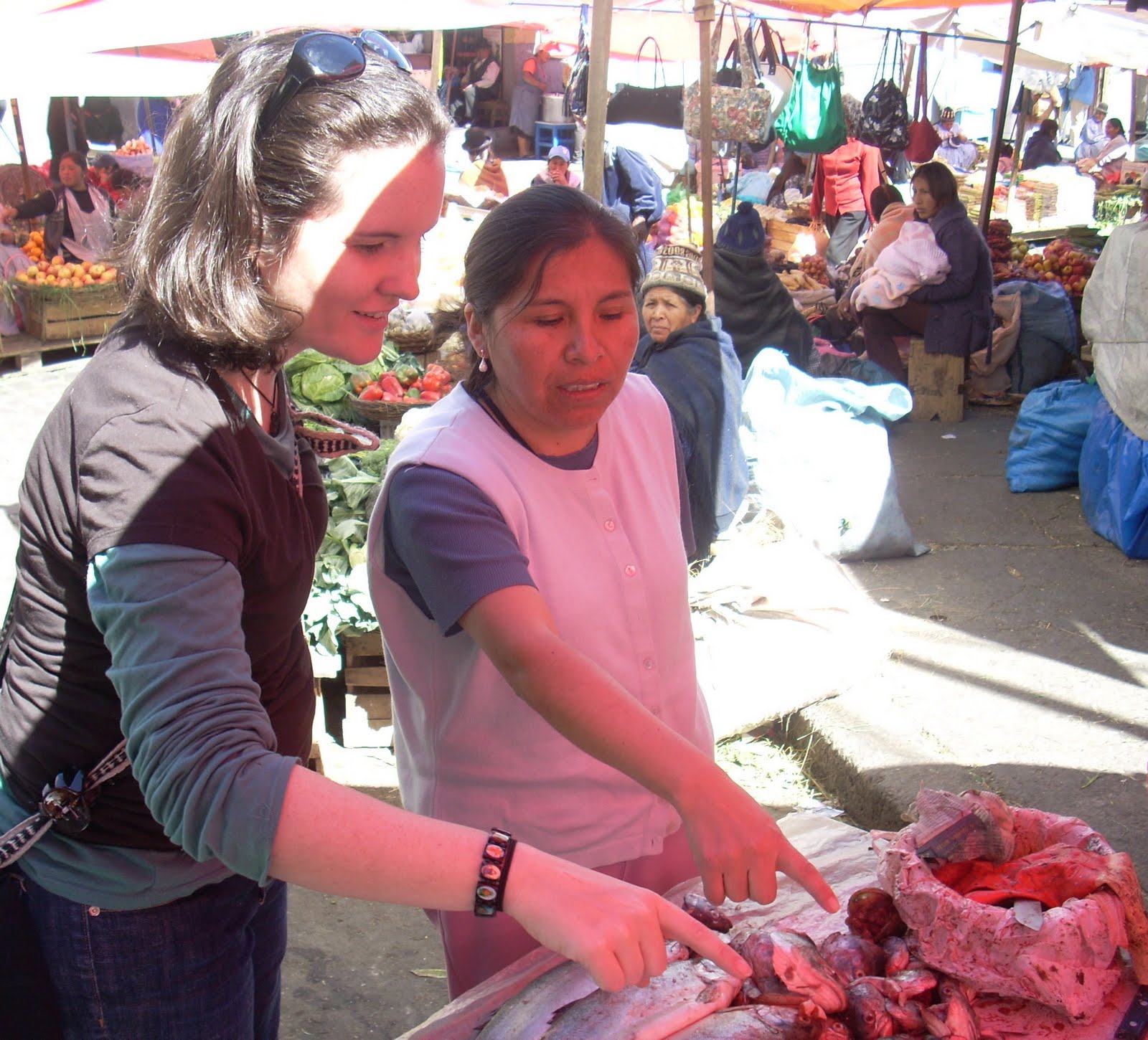
We started by buying fish. White fish and trout from Lake Titicaca.


Nora and I switched between Spanish and English, as we both need practice. She helped me learn a lot of new vocabulary for local fruits and vegetables that I’ve never seen before.


The fishmongerista (that’s my spanglish, not the actual word) cleaned the fish very deftly right there in front of us. Which I found surprisingly fascinating, but maybe I’m just drawn to gore.


We also bought shrimp. These come in from the Peruvian coast.


Foods that were new to me included a sweet fruit called chilimoya…


…and eggs from a small bird called cocornes.


Men kept stopping us to ask if we needed someone to help carry our things. We didn’t need the help, but here is one more nicely dressed gentleman taking advantage of the service.


Everything was there in bulk. From produce like potatoes to snacks to meat to soap!


We took a minibus up to another part of the market where we could find the things Amanda needed. These included cell phones for herself and her husband, as well as a high chair and portable crib for her daughter. The minibus will likely become a favorite transport of mine if they have them in Oruro (and they go where I need to go.) Each one has a conductor who yells out the route and crazily cheap price (one boliviano…1/7 of a dollar).


The altitude is still catching me short of breath or with a racing heart rate now and again, but it really isn’t too bad just now. I’m surprised to find I have an appetite and was able to make an lengthy physical excursion today. And of course, I’m staying hydrated, sometimes with the cheap bags of water you can buy and drink by tearing off a corner…ah, it’s good to be back in Latin America.